
Frequently Asked Questions
(Product Maker Perspective)
General
- What services does Rbate offer to manufacturers and service providers?
- How does Rbate work?
- What benefits does Rbate offer manufacturers and service providers?
- Why fund and encourage consumer advice providers when I can advertise instead?
- I've already partnered with a consumer advice service. How is Rbate different?
- Aren't there plenty of product reviews already available?
- Will consumers and help providers have confidence in the integrity of the bonus funding system?
- How can Rbate increase the sales of my products and services?
- How to I fund my rebates, bonuses, and fees?
- What is Rbate's fee schedule?
- Are my Rbate balances safe?
Products
- What intelligence does Rbate provide about my products?
- How do I add my product to Rbate's product search engine?
Rebates
- What is a Rebate Group?
- What value of consumer rebate should I offer?
- How do purchasers claim their rebates?
- How am I charged for purchaser rebates?
- How do purchasers obtain the Claim Code for their rebate claim?
- How can I minimise fraudulent payment of rebates?
- What is Claim Code activation and when should I use it?
- How to I handle product returns?
- When should I use standard Rbate secure rebate cards?
- What is the cost of standard Rbate secure rebate cards?
- When should I use raw downloaded Claim Codes?
- What is the cost of raw downloaded Claim Codes?
- How can I distribute Claim Codes using media of our own design?
Helpers & Bonuses
- What is Rbate Helper? How to I encourage them to work with my products?
- What is a helper bonus? How much should they be?
- How does Rbate compare with affiliate programs?
Survey Questions
- How do I survey product purchasers?
- How do survey my customers or prospects at other times?
- How do I survey those who decided to purchase a competitor's product?
Miscellaneous
-
What services does Rbate offer to manufacturers and service providers?
Rbate offers six services to product makers. You can choose which combination of services you wish to use (with some restrictions, as indicated below).
The services are:
A way to find out which professional sources of consumer advice (reviews, demonstrators, consultants, etc.) are covering each of your products, and which of these consumers are most using. This is a free service.
An easy and low-overhead way to offer and pay cash rebates to those who buy your products, online promotion of these rebates, and propagation of the trustworthy and balanced consumer reviews that stem from these rebates throughout the online and offline worlds, building the reputation of your company, brands, and products.
An easy way to survey those who buy your products, both during rebate claims and at other times.
A way to get intelligence on lost sales by surveying those who buy competing products. Requires prior use of the rebate payment service.
A way to (1), encourage consumer advice providers to better cover your products, (2), fund those providers who help your customers, and (3), find out which works and services have given your customers the most help. Requires use of the rebate payment service.
The ability to list your products in Rbate's product search engine. Free, but requires prior use of Rbate's paid services.
Other than the cost of Claim Codes, there are no up-front payments. You are only charged for tangible results after a product was sold — your customer was helped, your customer was rewarded, your customer gives you feedback, someone else's customer gives you feedback — increasing sales. Better than paying for the chance of an eyeball on an ad or a webpage.
You can give Rbate a try by creating a Rbate Maker account.
-
How does Rbate work?
For product makers that take advantage of all Rbate's services, Rbate works like this:
Rbate gives product makers a way to offer and pay low-overhead cash rebates to purchasers of their products.
When purchasers submit a rebate claim on Rbate.com they are given an easy way to cite the services, publications, and other media that helped them make their choice.
Purchaser citations determine the distribution of a bonus the product maker pays to those helpers that are registered with Rbate, fulfilling their published bonus offer, and funding those help providers that have prompted the sale.
Because help providers are able to browse available bonus offers, these offers also encourage a general increase in the amount of consumer help that involves products that attract a Rbate bonus.
And because consumers can use their rebates to both make donations to cited helpers and pay helper fees, rebates themselves provide some support to helpers who do well-regarded work on the maker's products.
Rbate also provides makers with the means to survey purchasers of both their products and other makers' products during the rebate claim process.
The services the maker has purchased from and through Rbate have only been incurred following the sale of a product, have helped make that sale happen, and result in improved help to, and feedback from, their customer base, increasing future sales.
Rbate also makes it easy to conduct surveys, outside the context of a rebate claim.
A full description of how Rbate works can be found here.
-
What benefits does Rbate offer manufacturers and service providers?
If you are an organization that manufacturers or distributes goods, or that supplies services, Rbate allows you to
Encourage organizations that provide consumers with product-related information, evaluation, recommendation, demonstration, or trial services (including stores) to start or expand work on your products, reducing your reliance on advertising as a way for consumers to learn about your products, and providing a better alternative to affiliate programs,
Monitor both the creation and use of media and services that help consumers evaluate your products,
Help fund those services that purchasers of your products declare helped them decide to make that purchase,
Get post-purchase feedback, not only from purchasers of your own products, but also from purchasers of other makers' products in nominated product markets,
Provide low-overhead, region-specific cash rebates to purchasers of your products, and
Make consumers and potential help providers aware of your new products through listing in a product-only search engine.
Rbate would complement your existing advertising program, increasing your sales by reaching the people and places that advertising can not.
Explore the alternative and register for a Rbate Maker account here.
-
Why encourage and fund consumer advice providers when I can advertise instead?
Advertising is becoming less effective as busy, streetwise, and bombarded consumers increasingly discount ads, ignore ads, use do-not-contact lists and technologies such as digital video recorders and on-line blockers to actively bypass ads, or simply purchase their entertainment and information outright. Are we seeing advertising's final flare, consuming the last of its consumer goodwill, before its collapse to a ember of its former self?
Some consumers, often technical experts who provide advice to friends and family, pay little attention to advertising, disliking its synchronous or push-based nature, instead seeking product information on-demand. The number of these early-disadopters is growing.
Moreover advertising delivers uncertain results — whether it's the up-front payments required for direct, circulation-charged, or impression-charged advertising, or the poor value-for-money and possibility of fraud with click-charged advertising. Fraud also occurs with online impression-charged advertising, where you can be paying to have your ad seen by a software robot or ad-blocker program.
Other alternatives to advertising, such as price-based co-marketing distribution deals with retailers (where periodic discounting is often compulsory) squeeze margins by failing to draw on the quality of products and brands, while simple product placement, endorsements, advertorials, and branded content are either subtle and ineffective or risk a backlash if too overt.
In an affluent society, time and satisfaction are more important than brand and price. Shoppers want help that allows them to most quickly and reliably find and buy a product with which they will be happy. Media and services that provide product evaluations, product recommendations, and product demonstrations are often the decisive factor in consumer choice, most particularly for large purchases, but also for smaller recurrent purchases where the number of alternatives is large. Such information can fulfil the same role as advertising in creating awareness, understanding, vibe, and desire, and Rbate makes it easy for consumers to browse such information by allowing them to request email alerts when new help-related media and services are available in their current areas of interest.Consumers want trustworthy information they can find easily, use freely, and digest quickly. Professional providers of purchasing help have a stake in maintaining a reputation for accuracy, honesty, and breadth of knowledge and experience, and have the resources to prepare and present information in a form that's easy to understand. Rbate's search engine makes these providers easy to find, and your bonus payments allow many of these information sources to be freely offered (making them much more widely used than paid media and services).
Your bonus offers encourage these services to work with your products — but you only fund these services to the precise extent that they inform purchasers in a way that results in a sale. You make no payment for any work that informed a lost sale, whether that work's overall assessment of your product was positive, neutral, or negative.
Despite knowing its flaws, you may be continuing to use advertising as your main promotional tool because you saw no alternative. We invite you to explore your new options.
-
I've already partnered with a consumer advice service. How is Rbate different?
Even if you have already have a relationship with one or more consumer advice services, consider the advantages of either replacing or supplementing these with the Rbate system:
- Rbate allows you to automatically support (and give consumers the choice of) many advice providers, without the work involved in negotiating a deal with each. Consumers feel more comfortable with help sources that don't have a direct relationship with product makers.
- Rbate makes it possible for advice providers to be paid for their work no matter where a product was ultimately purchased, and irrespective of what combination of helpers the consumer used. Helpers appreciate this for its fairness, and consumers appreciate that it makes a wider variety of help media and services viable.
- Rbate gives Helpers several funding options, and gives consumers better disclosure of the way each advice provider has chosen to operate, promoting trust.
-
Aren't there plenty of product reviews already available?
Very few professional review, recommendation, and demonstration services are wholly and directly funded by consumers through either subscriptions or fees. Consumers baulk at paying subscriptions for information they'll only occasionally make use of, and, except for some large or complex purchases such as property and insurance, are not willing to pay fees for a service that may end up not being that helpful. Reviews in magazines and newspapers are partially funded by subscriptions, but this subscription revenue is slowly drying up in the face of freely-accessible information on the Web.
Without the backing of subscriptions or fees, reviews must be funded by advertising, while recommendation and demonstration services are usually tied to a sales service. However, as stated in the previous answer, advertising's decreasing effectiveness means that it is not a secure way to fund purchasing advice services. Moreover, the general move of just about everything to an ad-funded model spreads the limited pool of advertising dollars more thinly. To boost advertising revenue some online review sites riddle their work with distracting advertising, or resort to excessive pagination (via short pages or long-winded expositions) in order to maximize advertising impressions.
Likewise, the potential of product recommendation or demonstration services is limited by them being adjuncts to sales services. Such services will either sell a limited range of brands (e.g. a car dealer), or often won't make too much effort to compare alternatives in case the consumer ultimately purchases from a low-service discount outlet. Many online review sites are also effectively involved in sales via links to affiliated retailers or price-comparison services, but miss out on any affiliate revenue if a purchase is made of a different product, or at a different time.
Aside from these professional review services, purchasing advice can be obtained through reviews and advice from other consumers. The trouble with information and opinion given by consumers is that it usually reflects only one person's experience with one product, is often terse, poorly-written, un-illustrated, anonymous, and unreliable, and it comes buried among a large number of similar postings. Your brands can be damaged by incorrect and badly skewed information. Such consumer feedback would however become a valuable resource if a professional service was able to invest the time to edit and aggregate them, tracking a product's performance through its lifecycle.
In summary, because of inadequate funding the potential of reviews and related services is not being realized. By encouraging such services to work with your products through bonus offers, and by funding those services in proportion to the help they give your customers through your bonus payments, you give a significant boost to the quality of information and advice about your products that is made available to potential purchasers.
You would see creation of many new services dedicated to providing consumers with purchasing assistance — services that are more likely to be free, ad-free, and independent of any sales service. For example, websites that provide automated purchasing advice, free recommendation services that consumers can call, and businesses dedicated providing consumers with product demonstrations and try-outs.
Informed consumers promote retail competition, so you are likely to be less beholden to demands by large retailers for deep discounts.
-
Will consumers and help providers have confidence in the integrity of the bonus funding system?
Consumers want to be confident that the advice they receive is unbiased, so Rbate only allows professional creators of media and services that provide consumers with purchasing help to register as Rbate Helpers. Such organizations have a reputation to protect, in contrast to systems where disclosed or undisclosed bonuses can be earned by "friends", "affiliates", "bloggers", or presenters of media testimonials.
Further, Rbate makes it possible for a consumer to see the way that a Helper has chosen to handle both bonus payments and bonus offer information. This can include an editorial policy statement, in which Helpers describe how they ensure that the receipt of bonuses does not influence the opinions they offer (though it will likely influence the type, subject, and intensity of the work they do). Consumers access this information via links found on results returned by searches performed on Rbate's purchasing help search engine.
Recovery of product selection service fees from suppliers is already well established for mortgage, insurance, and investment brokers. Rbate simply extends this model to professional services and media that help people purchase all other types products and services, as well as eliminating the need for any direct relationship between product suppliers and the organizations that evaluate their products.
Such an open and professional system gives all participants confidence that it is working to their mutual benefit. It has several advantages over the alternatives.
-
How can Rbate increase the sales of my products?
Each of Rbate's services works to increase sales of your products.
Your bonus offers increase the quality and quantity of assistance available to potential purchasers. Existing Helpers are given an incentive to start or improve their coverage of your products, while new Helpers are encouraged to begin offering information and advice about those products. Such exposure can rapidly give your product a self-sustaining critical mass. The prospect of bonus income will lead to new types of purchasing help being offered, such as automated purchase advisors, and businesses dedicated to providing personal advice and demonstrations, making it easier for potential purchasers to discover your product, and to see to if it suits. Consumers can easily find these media and services by using Rbate's dedicated purchasing help search engine. Because purchasing advice as been so hard for consumers to track down and use, many consumers have learned a helplessness when it comes to comparison shopping, accepting that they will usually have to take a punt and be stuck with their choice, for better or worse. Advice that is easy to find and use can change this thinking, opening consumers minds away from a focus on price, availability, and familiarity. Improved consumer information is also your best means to fight market clutter and commoditization, gaining the premiums your products deserve. Like some mortgage, insurance, and investment brokers, some Helpers may decide to only work with products that offer bonuses over some threshold amount. Alternatively, Helpers may respond to higher bonuses by devoting more resources to those products. This could manifest as better trained staff (reviewers, consultants, and demonstrators), more detailed analysis (both on product launch and over the product's lifecycle), clearer, more detailed consumer presentations, or, if the Helper is a retailer, a decision to stock the product. Fractions of your bonus payments can be forwarded to contributing Helpers, providing an incentive for Helpers to collaborate to present information in a way that makes it easier for consumers to find comfort in an informed choice. While your bonus offers encourage a general increase in the help available to your potential customers, your rebate and bonus payments are precisely targeted to maximize the quality of help available to your future customers. Bonuses are paid for work that led to a current sale, cumulatively providing the most support to those services that have made the most difference, both to consumers and to product sales (even if some those Helpers had chosen to hide information about the bonuses on offer). And because rebate claimers are given an easy way to donate part of their rebate to the organizations that have helped them, and to use their rebates to pay Helper fees, to some extent the rebates you pay through Rbate also provide such support. Your bonus offers, bonus payments, and rebate payments therefore increase product visibility and consumer understanding, priming future sales. Your Rbate account provides you with valuable information on Helper activity connected with your products. You can see which professionally-created or professionally-edited material and services are covering your product, which of these consumers are using the most, and, if you offer bonuses, which have given the most help to your customers. This ability to track the newest, most influential, and most highly regarded sources of information about your products (including collections or digests of consumer-written reviews) gives you valuable feedback on your work. Your rebate payments need not only act as an incentive for purchasers to complete the claim process, but can be used both as an incentive to purchase and as a customer reward. If you use Rbate's secure cards, or if you sell online and deliver your Rbate Claim Codes by email, the rebates you offer through Rbate have, like coupons, low overheads. But unlike coupons you do not need to make arrangements for retailers to accept them. You can if you like use Rbate solely to provide purchaser rebates, promoting your product and earning bid credits; there is no requirement to simultaneously offer helper bonuses or to issue survey questions. When you survey your rebate claimers you can find out why they decided to buy your product, and what they like and don't like about what they've bought after their initial period of use. This can guide improvements in both marketing material and in the products themselves. You can also gather customer contact information to initiate and maintain customer relationships. If you use Rbate's bid question service you can ask consumers why they purchased a competing product, telling you how to tweak your products and pitch to capture more customers. Finally, listing your products in Rbate's product search engine allows both early adopters and Helpers to be notified when you release a new product, and allows consumers to see your product when they use the service to search or browse for something they're after. Each Rbate service can be seen to offer excellent return on your investment. -
How to I fund my rebates, bonuses, and fees?
Each Rbate Maker account is associated with one or more currency balances. Balances can be held in the following currencies: US Dollars, Australian Dollars, Canadian Dollars, Euros, British Pounds, New Zealand Dollars, Singapore Dollars, and South African Rand. Deposits can be made via bank transfer and Skrill (Moneybookers).
You draw on these balances to pay rebates, bonuses, fees, and question bids, as well as to purchase Claim Codes and claim cards. Claim codes and cards can also be paid by credit card. Rebates and bonuses are denominated the currencies of your choice, while all other charges are denominated in US Dollars. Rbate will however automatically perform a currency conversion to cover a charge, which means that you need only hold a single currency balance with Rbate in order to pay any rebate, bonus, or US Dollar charge. Rbate does however impose a 5/2% risk spread on all currency conversions, with the exception of (US Dollar) Rbate fees paid from an Australian Dollar balance. This means that it is more cost-effective to hold funds in the currencies in which you will be paying rebates and bonuses; and you should maintain a US Dollar balance if your company has easy access to US Dollar funds. -
What is Rbate's fee schedule?
As well as the charges for downloaded Claim Codes and Claim Code cards, Rbate charges the following fees:
Processing and payment of rebate claims $0.75 USD per claim. Customer surveys
(outside rebates)$0.10 USD per survey. Processing and payment of survey rewards
(outside rebates)$0.50 USD per survey. Survey question answers from rebate claimers and survey recipients $0.02 USD per answer. Survey question answers from claims on other Maker products $0.20 USD + 10% of bid amount
(90% of bid amount is paid to answerer).Brokerage of Helper services $1.60 USD per claim with full bonus payment, pro-rata for partial payments, nil where no Rbate-registered help has been rendered. There is a $16 USD charge for deposits made to Rbate's U.S. bank account via wire, and a $4 USD base fee for each withdrawal from one of your currency balances. Extra fees may be charged for some withdrawal methods, the applicable fee being displayed when the withdrawal method is selected.
Rbate performs currency conversions using the daily reference rates of the European Central Bank, plus a 5/2% risk spread. This risk spread is waived when Rbate fees are paid in Australian Dollars.
10% Goods and Services Tax is added to all charges applied to Maker account holders located in Australia, with the exception of charges for secure cards.
-
Are my Rbate balances safe?
Rbate is not a bank, so the currency balances in Rbate Maker accounts are not government insured. However Rbate makes no operational use of these funds, holding them in trust to apply when either a consumer claim is submitted or Claim Codes are ordered. No account-access or maintenance fees are charged.
Each of your currency balances need only be sufficient to prevent claims from being unexpectedly rejected due to lack of funds to pay rebates, bonuses, and Rbate fees. That is they should cover the expected value of consumer claims until you can respond to either a low balance warning from Rbate or the low balance itself by topping up the balance in question.
If you have over-deposited in one of your currency accounts you can request a withdrawal.
Your balances are refunded if you close your Rbate Maker account.
-
What intelligence does Rbate provide about my products and services?
Rbate provides you with information about those who purchase your products, information from those who purchase competing products, information about which media and services are offering information and advice about your products, and information about which media and services were used by your customers.
For each product in the products table on the the Products Page of your account you can view the following quantities, totalled over the selected date range.
The number of rebate claims made for that product.
Your rebate redemption rate (claims to codes ratio). Use this to measure the sufficiency of your consumer rebates.
The number of Rbate-registered media or service entities (Help Entities) that have covered or are covering that product. Click on this number to see a list of the twenty most recently-created entities.
The number of times these media and services have been Rmarked by Rbate-registered consumers — one measure of the aggregate use consumers are making of these entities. Even if the number of Help Entities is small, the number of Rmarks will be high if some of them are highly popular. Click on this number to view a list of these publications and services in reducing order of Rmark count.
The total citation credit for that product. Citation credit measures the aggregate help that Help Entities have rendered to purchasers of your products, independent of the bonus amount, which together determines your total bonus spending. Click on this number to view an list of help sources ordered from most help rendered to least help rendered.
Your total spending on this product in US Dollar terms. Click this figure to see a break-down into its rebate, bonus, and fee components. This information is also viewable via the account transactions links on the Account Page.
-
How do I add my product to Rbate's product search engine?
Listing your product in Rbate's product search engine allows both consumers and potential Helpers to learn about your product. Search engine users can ask to be emailed when a new product is listed that matches a particular combination of search terms, product category, and area of availability.
A product will be included in the index when (1), the product has been assigned a product category, (2), the "List in Search Index" box is checked when the product is saved on the Products Page, and (3), your total spending on Claim Codes and Rbate fees equals or exceeds $10 USD times the number of products you wish to have listed, added in the order in which they were registered with Rbate. This third condition is designed to improve the quality of the product index.
-
What is a Rebate Group?
A Rebate Group is a collection of Claim Code orders that share both a common consumer rebate currency amount, and a common consumer survey. They usually correspond to the Claim Codes you distribute for and with a product in a given country or territory, but may also be created for particular marketing campaigns. Like products, Rebate Groups are identified by a private handle of your choice.
View the Rebate Groups for a given product by clicking on the "show" link in Rebate Groups column of the product's row in the product table on the Products Page.
-
What value of consumer rebate should I offer?
Consumer rebate amounts and currencies can be set independently for each Rebate Group. It is up to you to set the level of consumer rebates you offer, but it's in your interest that they be sufficient to encourage diligent completion of the claim process. One restriction is that consumer rebates must be a whole number of units of the currency in which the rebate is denominated. For example, a given number of dollars, and no cents.
You can choose to have a rebate displayed along with its product in Rbate's catalog. A rebate is only shown to users located in the region in which that rebate applies. Rbate allows major general-purpose search engines to index the information about each product and rebate.
You also have the freedom to supplement a rebate for any other marketing reason, including promotions and discounting, or to offer rebates solely for this purpose (without any bonus or survey). Rebate payments also earn you bid credits.
Consumers respond well to cash rewards, particularly if they are easy to claim. Hard-to-claim rebates, the offer of prize-draw entries, or requests that consumers give their time and information freely, can be effective in the short-term and with certain people, but interest and goodwill wanes as the effort or odds become apparent. Cash rebates gain you the best quality information from the widest range of purchasers, for the longest possible time. They can also form part of a promotional coupon system.
Further, when purchasers claim their rebates they are given the option to donate some or all of their rebate to one of the organizations who helped them choose that product. Helpers can also charge their users a deferred fee for using their service or accessing their content, which is recovered from their rebates. Thus the rebates you offer through Rbate support the Helpers whom your customers have either found helpful or have "paid" to use.
Finally, Rbate contacts rebate recipients sometime after their claim, inviting them to submit a review of their product, no matter where it was purchased. Rbate gives its Helpers free use of these reviews. Thus reviews that are trustworthy (because they are marked as coming from validated purchasers) and balanced (because prompting for feedback encourages positive impressions to be recorded, not just those prompted by problems) can be incorporated into the work of many publications and advisors, building the reputation of the reviewed product, as well as the associated brand and company, without the risks of artificial reputation boosting.
Given these benefits, along with the access they give you to the sales-boosting Rbate bonus and survey systems, Rbate purchaser rebates are good value for money, particularly if you currently offer rebates by either redemption or coupon.
-
How do purchasers claim their rebates?
Purchasers claim their rebates by visiting rbate.com/claim and entering the unique 20-character Claim Code that you provided with their purchase.
If you have a presence at the point of sale, you can issue purchasers with Claim Codes that you have downloaded from Rbate. Otherwise, you can still avoid the expense of verifying rebate eligibility by attaching Rbate's secure cards to your products, with or without the requirement for point-of-sale activation
You need not provide a rebate to all purchasers. For example, you may like to only supply a Claim Code (as a card or otherwise) to purchasers who redeem a coupon. Another possibility is to advertise a cash rebate that makes your product free or less expensive for those who send you proof that they have purchased a competing product. This encourages sampling, which may lead to consumers switching preferred brands.
Only one in many billions of Claim Code combinations is valid and active, and techniques are employed to detect automated claim attempts, so it is extremely unlikely for a non-purchaser to make a successful claim (there is no Maker liability for any claim where a code was guessed).
You have the option of placing a company or brand logo at the top of the page during claims. Such a logo can be set on your Profile Page. Logos are not displayed if the claim is running in a frame on your site, allowing you to provide your own branding.
After entering a valid code, purchasers are led through the process of citing the media and services they found helpful.
The next step is the buyer's survey, skipped if no survey has been specified for the Claim Code's Rebate Group. Bid questions, if any, follow the maker's survey.
If the claimer has any outstanding deferred helper fees, they are now informed that these will be deducted from their rebate, unless they wish to dispute a charge.
Next, claimers are given the option to donate part or all of their rebate to one or more of their cited Helpers.
Finally, claimers are asked to supply a payment account into which their rebates should be paid.
You are given the option to direct rebate claimers to a webpage of your choice when they complete the claim process.
When the claim is submitted your Rbate currency accounts are debited for the value of the rebate, any pro-rata Helper bonus payment, plus Rbate fees. Your deposit is returned if the Claim Code was of the download type.
Click here to perform a test claim.
-
How am I charged for purchaser rebates?
Rebates are charged against the currency balances you hold in your Rbate account. At present, rebate amounts for a Rebate Group can be set in the following currencies: US Dollars, Australian Dollars, British Pounds, New Zealand Dollars, Canadian Dollars, South African Rand, Euros, and Singapore Dollars. If at the time of a claim your account balance in the rebate currency is insufficient to cover the rebate, Rbate will attempt to pay the rebate from your largest currency balance, eliminating the need for you to hold balances in all currencies in which you offer rebates. The consumer claim will be refused if none of your balances have insufficient credit.
At the present time, if this occurs claimers will be told to try again later, and you will be sent an email indicating that a claim was refused due to insufficient credit, and that you have two business days to deposit funds. After this two day grace period those who make subsequent claim attempts will be informed that you have been delinquent in your responsibility to fund your promised rebates, and they will be directed to contact you to resolve the matter. Rbate may withdraw the courtesy of a grace period from accounts that abuse it.
-
How do purchasers obtain the Claim Code for their rebate claim?
You order Claim Codes from Rbate in multiples of 1000, either as downloadable raw code sets, as rolls of standard rebate cards, on which the codes are securely concealed, or on custom media of your own design. You then distribute these codes with the appropriate products. Consumers submit their claim on Rbate.com using these codes. Rbate handles all processing and payment of these claims.
Claim codes can be purchased through the Rebate Groups link for the product in question, found on the Products Page of your Rbate account. You can either pay for codes and cards from your account balances, by credit card, or directly from a US bank account. -
How can I minimise fraudulent payment of rebates?
To ensure that rebates are only paid to product purchasers, you should do one of the following:
- Require purchasers to send you proof-of-purchase, after which you either send them a downloaded code (perhaps as a link) or activate their code so it becomes claimable.
- Activate codes at point-of-sale by scanning barcodes on code cards or cards.
- Supplying claim codes at point-of-sale, either on cards or from a code download.
- Placing claim cards securely inside packaging.
- Checking the integrity of claim code cards at point-of-sale, and using your Rbate account or the Rbate API to cancel any that are revealed or missing (cancelling when neither a code or a barcode remains will require you to be able to match rebate card barcodes to product serial numbers through a factory, warehouse, or retail process).
- Using store security to prevent or detect rebate card tampering. If audits are performed fortnightly, tampered codes can be cancelled before those rebates are paid.
When a product is returned, you're able to check the status of its rebate claim, allowing you to either return the product to stock, cancel the original code and attach a new one, or, if the rebate has been paid,
-
What is Claim Code activation and when should I use it?
If you select the "Require Activation" option on a Rebate Group, each Claim Code in that Rebate Group needs to be individually activated by scanning a barcode on the rebate card/card (or by entering the associated barcode number) before that code can be used to make a rebate claim.
These activations are either done at point-of-sale (either by you as product maker, or by a retailer using an Rbate Helper account that you have authorised), or after you've validated a purchase yourself. This latter option allows you to activate rebate cards of validated purchases without sending anything to the purchaser, although an alternative is to eschew rebate cards and email validated purchasers rebate claim links. Requiring code activation makes it harder for someone to fraudlently receive a rebate by either stealing products or surreptitiously revealing codes. You may however decide against requiring code activation if the nature of your product or retail environment make this unlikely, if you will do your own purchase validation (by for example only issuing Claim Codes to those who send you receipts, needed when you require multiple purchases for rebate eligibility), if some of your retailers don't have the infrastructure to handle activation, or if you are happy to rely on Rbate manually inactivating codes for you if you can promptly detect theft or fraud.Instructions on how to activate Claim Codes can be found here.
-
How to I handle product returns?
When a product carrying a rebate is presented for return, you have the ability to check whether the purchaser has already claimed and been paid their rebate. If not, you can prevent that purchaser being paid their rebate so that the item can be re-sold, perhaps requiring a new Claim Code card. When a rebate has already been paid, you are told the payment amount and given the opportunity to disable rebates on replacement products, helping you decide how to handle the situation.
-
When should I use standard Rbate secure rebate cards?
Rbate-printed secure rebate cards allow you to offer, advertise, and pay cash rebates without either you or your customers having the hassle and expense of verifying rebate eligibility through receipts or other proof of purchase. They are an alternative to raw code downloads. Features of standard Rbate cards can be included in custom Claim Code media, which Rbate can make and deliver to your specifications.
Boxes of these cards can be ordered from Rbate and either placed inside product packaging, secured in a transparent pouch on the outside of product packaging, attached to invoices, issued at point-of-sale, or posted to the purchasers you have separately verified. Each card holds a Claim Code under a scratch coating.
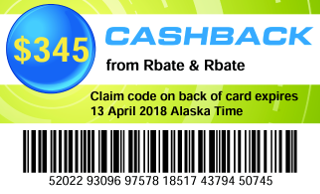
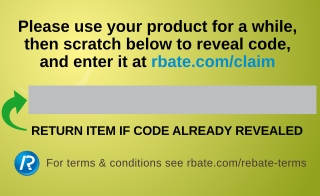
The front and rear layouts of a standard 90mm x 55mm Rbate secure rebate card are shown below.
Rbate can supply plastic pouches that allow the cards to be attached to the outside of packaging, which both advertises the rebate and makes it obvious if a card has been stolen or tampered with.
Either your registered Rbate company name or the brand name of the product (both set through the Profile Page, and selected on the Products Page), will be printed on cards as the supplier of the rebate.
Also on the front is a barcode that can be scanned at point-of-sale for easy anti-fraud code activation on purchase, and claim status retrieval when a product is presented for return.
On the rear of the card is the 20-character Claim Code, hidden under a scratch-off pane.
Point-of-sale staff should be informed as to which products will be carrying rebate cards external to their packaging, allowing them to make sure cards have neither been removed or tampered with (the packaging or pouch will be damaged). It would be helpful if consumers were also told to expect the presence of a rebate card.
-
What is the cost of standard Rbate secure rebate cards?
The following charges apply to each order of standard secure cards:
Thousands of cards in the order Price per card, USD 1-9 0.50 10-99 0.28 100-249 0.17 250-999 0.06 1000+ 0.04 plus UPS shipping charges and a $15 USD per order handling charge.
At present, cards are only able to be delivered to those countries listed in the destination address country selector in the code order form on the Rebate Group page.
-
When should I use raw downloaded Claim Codes?
Raw Claim Codes are supplied as a downloadable file, which contains one Claim Code per line. These should be used when you do not wish to order rebate cards. This may be because you either wish to print your own cards, sell products directly to consumers or otherwise obtain purchaser contact information at point of sale, or wish to first communicate with the purchaser in order to verify their purchase through supply of a product serial number or invoice before directly supplying them with a Claim Code.
When you supply a Claim Code to a customer you should direct them to make their cashback claim at Web address rbate.com/claim. You can save the customer from having to enter the Claim Code at the Rbate site (or in the Rbate claim frame on your site) by appending the Claim Code to the Web address: e.g. https://rbate.com/claim/A9YK7-Z82JC-6VY5W.
-
What is the cost of raw downloaded Claim Codes?
The only charge for downloaded Claim Codes is a 1 US cent per-code deposit. The deposit is required because Claim Codes are a limited resource. A downloaded Claim Code's deposit is refunded when a consumer completes a rebate claim using that code.
-
How can I distribute Claim Codes using media of our own design?
Contact Rbate if you wish to provide Claim Codes to purchasers on media of your own design, and wish Rbate to help with the design an manufacture of this media. If you wish to develop and supply your own media, you should instead order downloads.
-
What is Rbate Helper? How to I encourage them to work with my products?
Rbate Helpers are individuals or organizations who are registered with Rbate as professional consumer assistants. Helpers may review your products, provide consumers with recommendations and information about your products, demonstrate your products, offer trials or samples of your products, or provide consumers with a complete purchasing or gift service.
There are two ways in which you can give Rbate Helpers an incentive to work with one or more of your products. First, you can use Rbate to offer a cash rebate to people who purchase particular products. Helpers are attracted to these products because they are able to receive a portion of these rebates through donations (Nods) and deferred fees. You can increase this incentive by offering and paying Helpers a bonus when their work leads to sales.
You can help recruit Helpers for your products by adding a link on your website to the Helper application page.
-
What is a helper bonus? How much should they be?
Helper bonuses provide a way for you to encourage providers of purchasing advice to work with your products. The bonuses you pay support those media and services whose work has been associated with sales of your products.
If a purchaser submits a rebate claim at a time when you have set an active helper bonus for the purchased product, the rebate claimer will be asked to nominate which services, publications, and other media helped them decide to purchase that product. If a Rbate-registered service or piece of material (known as a Help Source) is cited by the purchaser, the Helper organization that created or operates that source is paid from your helper bonus in proportion to the strength of that citation ("very helpful" or "helpful"), and in inverse proportion to the total number of citations. No bonus or fee is charged if no Help Sources are cited. Fractions of your bonuses may be distributed to other Helpers if the cited works depend on the work of others, as tracked in Rbate's contribution network.
You can choose the currency in which a bonus is denominated. This should be the currency in which most Helpers are likely to want to work. For products only available in a single country, this will be that country's currency. But you should choose a suitable global currency for globally-available products.
When you set a helper bonus you are also asked to set an expiry date, before which the bonus amount cannot be reduced (and this expiry date cannot be brought forward). The bonus amount, bonus expiry date, and the Claim Code expiry dates for that product together form an active bonus offer, which Helpers can choose to make visible in their Rbate accounts, alongside other offers in that and other product categories.
Helpers will expect bonus offers to be sufficiently large and sufficiently prolonged that it is worth their while to consider whether they should change the work they do in response. Therefore, as well as a firm period of validity, the value of each bonus offer not must be below a limit that Rbate has set for each category of product. This will often be few percent of the average price of products in that category. You will not therefore be able to set a helper bonus for a product until that product has been assigned a product category.
To help you evaluate the competitiveness of your offers, the minimum-limit, minimum, average, and maximum bonus offers in a product's market (category and availability region), taken over all Makers, is shown for each of your Rbate-registered products displayed on the Products Page of your account. Clicking on these values takes you to a bid projection page where you can see how these values will evolve as a consequence of the current expiry dates of these competing offers. You can evaluate the effect of a bonus offer by tracking changes in the number of covering Help Entities, Rmarks, and sales/claims for the product in question.
Remember that helper bonuses are only paid after a purchaser makes a rebate claim following the sale of one of your products, and only to the extent that the media and services the purchaser cites were both Rbate-registered and instrumental in the purchaser's choice. Helper bonuses therefore offer excellent return on your investment in the Rbate service. This is particularly true if Rbate bonuses replace some of the affiliate payments you currently offer.
-
How does Rbate compare with affiliate programs?
Rbate's way of encouraging and rewarding consumer assistants has a number of advantages over affiliate links and relationships:
Rbate's bonus, Nod, and deferred fee systems work with both online and offline sources of consumer assistance, including consultants, demonstrators, and offline media (newspapers, magazines, TV, etc.), allowing your encouragement and rewards to have a greater reach.
Rbate's system is not tied to particular retailers, but works wherever consumers make their purchases. Ad-blockers remove many afffiliate links, because the target vendor is often manually or automatically chosen as the one that will maximise affiliate revenue rather than consumer satisfaction.
Your payments to Helpers vary according to how influential a Helper was on a purchaser's decision. A payment will be lower if the purchaser made use of other sources of help, such as additional Helpers, private advice, or their own research, or if the purchaser cites a source of advice or information in the "helpful" rather than the "very helpful" category. This allows you to be comfortable with a single bonus offer, and not have the trouble of negotiating individual deals or payout rates.
Affiliate programs only reward helpers who mediate sales. In contrast Rbate allows you to fund and encourage other sources of influence, such as those that point out problems with competing products. A consumer's path to purchase now oftens consists of dozens of micro-moments, and Rbate allows you to influence a number of these.
Further, Rbate greatly reduces what you have to pay to affiliate sites that provide false or poor information. This is because even though they may induce a sale, and their Help Source may get Rmarked as helpful, that Help Source is unlikely be cited as helpful when the purchaser makes their rebate claim after using the product. Such citations are what determines Rbate's bonus payment distribution.
You no longer have to make large payments for simple referrals on sales that consumers may have found, selected, and purchased in other ways. For example, when a purchaser visits an affiliate and clicks their link after entering your brand into a search engine or browser address bar. Affiliate links may also be fraudulently or secretly activated.
Conversely, Helpers can get paid for all the well-regarded help they provide, rather than only when they also happen to mediate a sale. Fair and appropriate payment encourages participation and quality work.
Rbate Helpers are professionals. Moreover, the Rbate system both enforces proper disclosure and eliminates the need for advice providers to have a direct relationship with you. This is not usually the case for affiliate links and affiliate/re-seller relationships. Affiliate sites that provide overblown sales pitches rather than quality independent advice can turn prospects off. Ethical methods and high-quality service builds consumer trust, reflects well on your business, and eases your own pre-sales work.
-
How do I survey product purchasers?
You have the ability to survey purchasers of both your and your competitor's products when purchasers claim their rebate. To discourage unnecesarily long surveys, Rbate charges a fee for each survey question answered by a product purchaser. Purchasers can give valuable feedback, and are a more select group that random individuals enticed to complete surveys solely for a promised reward.
Purchasers are asked to delay making their rebate claim until they have made some use of the product they have purchased, allowing you to get better feedback on consumers' opinion of your products, including from the usually-silent majority. As part of the survey you can also ask questions about why the purchaser chose your product, and request identifying information about the purchaser. If you already know customer identities, you can record which Claim Code is issued to each customer, which allows you to identify survey responses without having to ask claimers for their identities.
If you use a Rbate buyer's survey to request personal identifying information from purchasers, you agree to fully describe, in either the text of the relevant questions or in the survey introduction text, the use to which that information will be put, and the nature of any third-parties to which this information may be disclosed. If you fail to abide by this condition Rbate reserves the right to either disable the surveys in question, or to refund your account balances and terminate access to your account.
Surveys are created on the Surveys Page of your Rbate Maker account, and selected on Rebate Group pages.
You create a reservoir of survey questions in the left column of the Surveys Page, and drag and drop these into question lists in the right column, forming surveys. Survey questions and surveys can currently only be created in English, however support for multi-language survey questions and surveys is forthcoming.
Four types of multiple-choice questions are currently supported: single choice answer, single choice with "other" write-in answer, multi-choice answer, and multi-choice answer with "other" option. In addition there are question types for answers of type text, date, email, number, location, product-category, and contact details (name, address, & email). Finally there is a message "question" type that allows surveys and survey sections to be introduced with a piece of text.
Texts of survey questions, survey question options, and survey introductions can make use of the following HTML tags: u, i, b, br, p, ul, ol, li, sub, and sup (enter < as <). To edit each of these these texts, as well as the handle names of questions and surveys, click them, edit them, then use the Enter key to confirm your changes. (Use Shift-Enter to move to a new line in the editing area.)
If a set of questions you wish purchasers to answer depend on an option the purchaser selected in an earlier answer, you can use the jump capability. To use this, click on the arrow that appears to the right of each question and each question option in the current-survey (right) column, and select the question you wish the purchaser to next answer once that question has been answered, or once that option has been selected. Survey-takers using JavaScript-enabled browsers will see the survey change as questions are answered, so that relevant questions are the only ones shown. When JavaScript is disabled instructions as to which question should be answered next are instead presented. You can see how a survey will look and work for purchasers by clicking on the Test link, located right of the current-survey title. You are not charged any Rbate fee for survey questions that are jumped over.
For each option in each multiple choice question the percentage rate at which that option has been selected is shown down the question's right column. These statistics are shown both for the question itself (across all surveys in which that question is present), as well as for answers given to that question in the survey displayed in the right column. A link is provided to search, view, and download the set of text responses given for both "other" options and questions having text answers. The "Responses" link allows you to view and download individual response sets for the current survey.
-
How do survey my customers or prospects at other times?
As well as surveying customers during post-purchase rebate-claims, you can use Rbate to survey your customers or prospects at any other time.
To do this, just create a new Rebate Group of the Survey rather than the Rebate type, specifying an optional payment for submitting a completed survey, and an optional webpage to which survey takers are redirected when they have successfully completed the survey.You then order Claim Codes for this Rebate Group, which you issue to those you wish to survey. This can be done via email, post, or via cards that you hand out. If a survey completion payment is offered, such cards can be a non-self-adhesive form of Rbate's secure cards, which allow you to safely issue them to retail or marketing staff.
If you wish a survey to be conducted on Rbate's site, you direct code recipients to make their claim at rbate.com/survey. If you can give code recipients a web link, you can save them having to enter the Claim Code at the Rbate site by appending the Claim Code to the Web address:
e.g. https://rbate.com/survey/A9YK7-Z82JC-6VY5W.By setting the Claim URL field of the Rebate Group you can instead embed the survey in your own website. On your Claim URL webpage you need to place an HTML frame or iframe which sources from either rbate.com/survey or rbate.com/survey/<CLAIM_CODE>. This embedding will only function at the Claim URL you have nominated.
If you track which people receive which codes, by, for example, linking codes to email addresses, you will be able match survey responses to individual customers or prospects.
Click here to conduct a sample survey. This survey offers a cash reward, so includes steps not present when no payment is offered. Where no payment is offered, and where the Claim Code has been provided in a web link, the survey process occurs on a single webpage.
-
How do I survey those who decided to purchase a competitor's product?
Because it's useful to know why you lost a particular sale, Rbate allows you to survey those who purchased products made by other Makers. This is done by using the Question Bids Page of your account to bid for the right to pose a particular question to those who claim rebates on products in particular markets (each a combination of a region a product category), and to receive an answer to that question. Ninety percent of a successful bid is paid to the claimer who has answered the question. Your own bid questions are never asked during claims on your own products.
To use the bid facility, first ensure that you haven't opted out of the Question Bid system on your account profile. Then create the survey question(s) you wish to ask using the left-hand column of the Surveys Page. Unlike the questions you can ask in surveys given to purchasers of your own products, you may not ask for any identifying information, nor attempt to contact the purchaser. This keeps customer details private.
After creating a question, either move to the Question Bids Page and click the button, or click the question's Bid button in the survey editor for that question to automatically select that question as the subject of a bid.
Each bid is associated with a product category and product distribution region, targeting the bid at all products in all markets that overlap both this category and region. You cannot at present specify that your question be given only to purchasers of specific products, however when you view the answers to text-response questions you are shown the name of the product associated with each answer.
Your bids are for the right to ask, and to receive an answer for, one of the limited number of bid questions (currently 3) that Rbate asks each rebate claimer. You can set a maximum amount for each bid, but your are only ever charged the 4th highest maximum bid in each market (i.e. the highest unsuccessful bid), or $0.10 USD if there are fewer than four bids, plus the Rbate fee.
A bid cannot become active until Rbate approves the question's text. Questions are automatically submitted for approval when a bid associated with an unapproved question is saved or updated. If you change the text of a question used on one or more bids, those bids will be inactivated until the new text is approved. You can submit a question for reapproval by re-saving one of the bids on which it is used. You will be notified when a question has been approved or rejected, and, if rejected, the reason for that rejection.
An answer credit system is also used to ensure that Makers who offer rebates and bonuses don't feel exploited by competitors, who can question their customers but, by avoiding offering rebates, do not allow their own customers to be surveyed.
Bids can only be successful in markets in which you have earned bid credit by paying a rebate in that, or a closely related, market. A credit fraction is deducted each time your bid is successful, and you receive an answer.
A bid can be set to inactivate when a spending limit has been reached, and bids can either be manually deleted or set to expire at midnight UTC on a given date.
Further instructions for placing question bids can be found on the bid details form on your Question Bids Page.
You will be emailed when a bid becomes active or inactive due to changes in your bid amount, changes in the amounts bid by others, bid credit changes following claims, bid expiry, or bid spending limits being reached.
View both text responses and the statistics of the multiple-choice answers you receive to bid questions in the normal way on the Surveys Page. Rbate doesn't charge you for questions that the claimer doesn't answer, or if Rbate detects that a text answer is effectively blank. However although the payment given for answers should result in a high response, accuracy, and quality rates, Rbate cannot guarantee that every charged answer will be useful or meaningful. So account for some attrition when deciding on your maximum bids.
-
How can I audit Rbate's work?
By withholding some Claim Codes from distribution you can assure yourself that Rbate is only charging for claims that result from purchases of your products, and is not improperly processing claims on other Claim Codes. From the code order status column of a product's Rebate Groups page you can download the list of redeemed Claim Codes for a code order. You should check that withheld codes do not appear on these lists.
Assess the sufficiency of a product's consumer rebate by its claim redemption rate, as displayed in the product table. And other than through sales volume, gauge the effectiveness of your bonus offers and bonus payments for each product by tracking the number of covering entities, the number of Rmarks, the level of citation credit, and your total spending.
Unlike some content-matching advertising brokers that take an unspecified proportion of the advertiser's bid, you are able to view a full breakdown of your spending on each product: rebates, bonuses, and the fees Rbate has charged for its rebate agency and bonus brokerage services.
-
How do I close my Rbate account?
If all your currency balances are nil, click the "DELETE MY RBATE ACCOUNT" button on your Profile Page.
Otherwise, first request withdrawals for each of your balances via the Account page. When you request the final withdrawal, check the box to request that your account be closed and deleted. If you do this your account will be automatically deleted after your last balance has been refunded.
Your account cannot be deleted if you have active Claim Codes.